A plugin-shaped future
Contents
The catching-up post ended with development pausing for a rebuild. Here's the thinking behind it.
The problem
Today, adding something to Prometheus means editing the core in a dozen places: the list of entity kinds, the component registry, the inspector, the menus, the tool windows, the frame loop, the save system, the event catalogue, script commands, the exporter and the server's validators. Nothing can be switched off without deleting code, and nothing outside the core can add to the engine.
Plugins, widgets and modes
The rebuild turns each of those places into a socket.
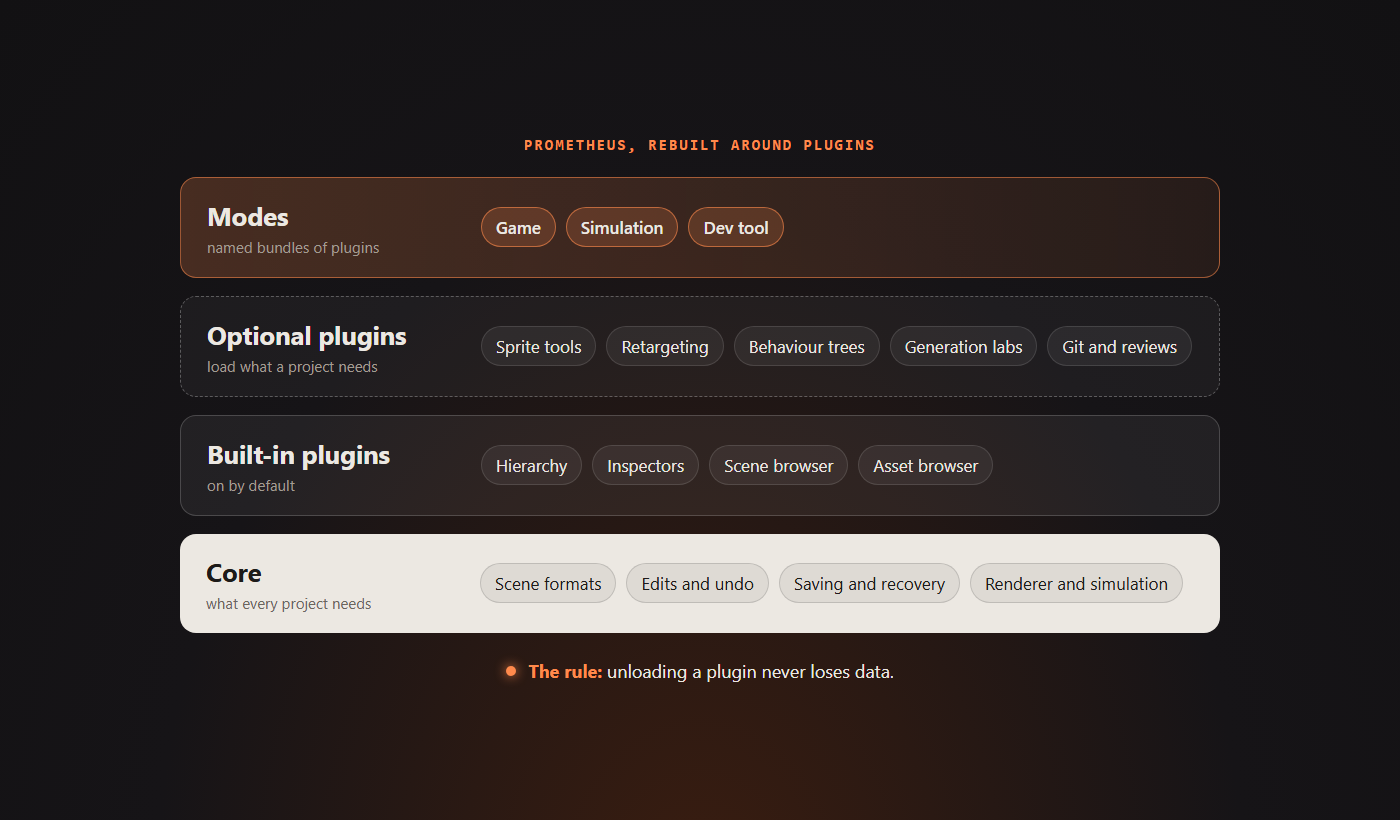
- A plugin is a package that adds capabilities: new kinds of entity, components, simulation systems, script commands, importers, server jobs.
- A widget is a piece of UI a plugin brings with it: a tool window, an inspector section, a menu item.
- A mode is a named bundle of plugins.
Modes are the part I'm most excited about. The same engine could be a game, a simulation or a 3D development tool depending on which mode you load, even one that renders apps or websites in 3D and lets you take them apart.
What stays in the core
Not everything becomes optional. The core keeps what every project needs: scene formats, edits and undo, saving and recovery, and the renderer and simulation lifecycle. The everyday tools, like the hierarchy, inspectors, scene browser and asset browser, ship as built-in plugins that are on by default. Specialist tools become optional plugins: sprite tools, retargeting, behaviour-tree authoring, generation labs, and git and review tools.
The rule it can't break
Unloading a plugin never loses data. A scene that uses a plugin you don't have loaded must still open, save, restore and export with that plugin's data intact, held exactly as it was. It's the save that deleted things, grown up: missing isn't the same as unavailable, so hold, don't drop.
The desktop and beyond
The editor is moving into a desktop app built on Electron, and it will keep running in a browser too. Further out there are two ideas: a faster backend, possibly in Rust, that can still run the TypeScript plugins, and a Figma connection for managing models and their updates. Those are plans, not promises.
The order is: settle the plugin contracts, build a minimal desktop editor, then move the first tool out of the core and into a plugin. After that the rest follow, one at a time.