A world that isn't there yet
This week I pinned down one of the most important rules of the game world, and it changes what the engine has to do.
Ground that nobody has reached does not exist. It isn't hidden or fogged over; it hasn't been generated. The dungeon is endless, so it gets built as it's explored.
Monsters explore too
Monsters don't idle in rooms waiting for a player to show up. They wander, head home, follow routes, and keep doing it when no player is anywhere near. When a monster walks toward the edge of the known world, terrain is generated for its path, and only its path. It learns the ground it has actually walked, not a circle of everything around it, and none of that reveals anything to players.
Terrain is shared: once it exists, it exists for everyone. Maps aren't. What each player has discovered is theirs alone by default.
The rules that hold it together
A few engine rules fall out of that:
- Nothing walks on nothing. Before any actor, player or monster, moves into new ground, that ground is generated and committed, with its collision and navigation. Nobody crosses a blank region, a guessed bridge or a floor that doesn't exist yet.
- First come, first fixed. Once ground exists, it stays. Otherwise a monster could head home to its den and find a lake there, because a player's arrival had regenerated the area. A player who turns up later finds the same trails, dens and residents the monster left.
- Budgets. An endlessly wandering monster could otherwise generate an endless world with nobody in it. Generation distance, active populations and simulation time all have limits, and when one runs out a monster waits at the edge rather than inventing ground.
- Reproducible from history. A seed alone can't rebuild a world shaped by what happened in it, so the engine keeps the seed, the generator version, the behaviour that shaped the world and everything that was committed.
- Not flat. Hills, valleys, cliffs, gaps and water. One spot on the map can hold a bridge above a cave, so a single height per point isn't enough.
Where it starts
None of this is gameplay yet. These are engine requirements, and the first building block arrived the same day: navigation. The editor can now bake a grid that says where an agent of a given size fits, and find a route across it.
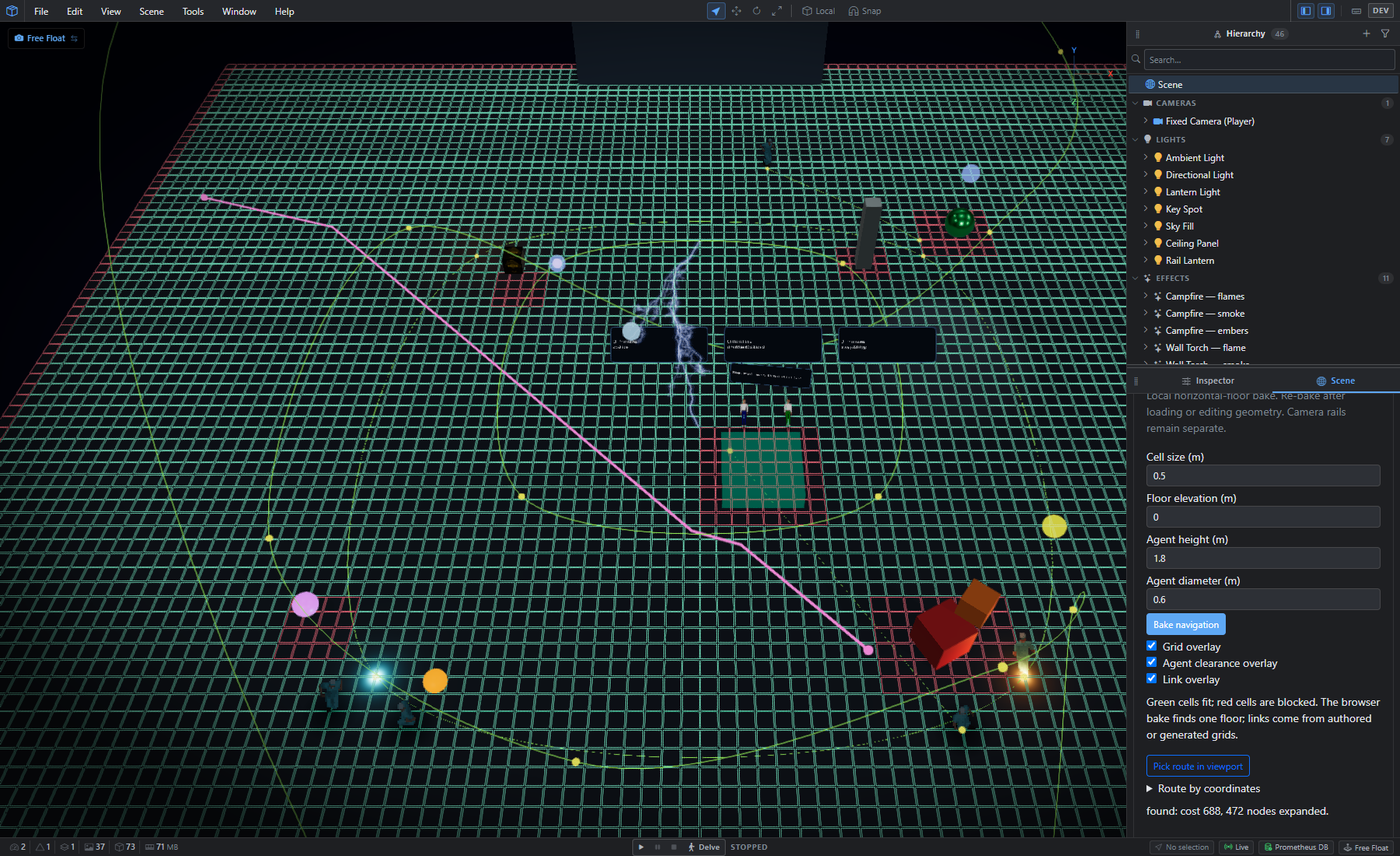
Today that works on flat floors in scenes I've built by hand. Terrain that generates itself as monsters walk into it is the long road from here.